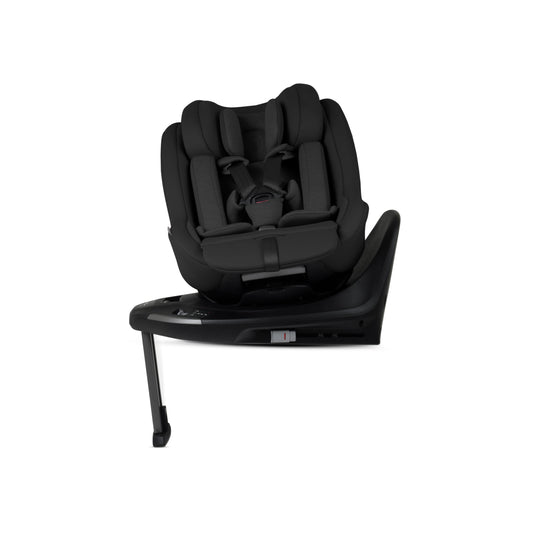
Choosing the right car seat is one of the most important safety decisions you can make as a parent. If you’ve been thinking about buying a car seat and are curious about what the term ‘extended rear facing’ really means, we’re here to help.
In this guide, we’ll walk you through the key facts about extended rear facing car seats, explain why rear facing travel is safer, and explore how long children benefit from staying rear facing.
What is ‘extended rear facing’?
Extended rear facing, sometimes abbreviated to ERF, refers to keeping your child travelling in a rear facing car seat for longer than the minimum required by law.
In the UK, current i-Size (R129) regulations state that babies must travel rear facing until they are at least 15 months old. After this point, parents are legally allowed to turn their child forward facing in a car.
Extended rear facing car seats are designed to go beyond this legal baseline. ERF car seats can accommodate children up until the age of four years old, with some offering rear facing travel up to 7 years old.
Why extended rear facing is safer
Rear facing car seats are widely recognised as the safest way for babies and young children to travel. This is because their anatomy is still developing, and they have relatively heavy heads to the size of their body, which puts more strain on their neck. Their delicate necks and spines naturally can’t withstand as much force, so it’s important to minimise as much impact as possible.

In a forward facing seat, the harness holds the body back while the head moves forward in a collision, which can strain the neck. In contrast, rear facing seats work by:
- Supporting the head, neck and spine together in a frontal collision
- Distributing crash forces across the back of the seat, rather than concentrating them on the neck
- Keeping the child contained within the protective shell of the car seat, limiting forward movement
Using an extended rear facing car seat means that your little one is kept in this safer position for longer. Real world research supports this approach. Large observational studies involving children aged 0–4 have found that children travelling rear facing are less likely to be injured than those travelling forward facing.
Did you know? Comparative research from the UK and Sweden shows that when parents receive clearer guidance about rear facing travel, children stay rear facing for longer - benefiting from higher levels of protection during their early years.
How long should a child stay rear facing?
Children are legally required to travel rearward facing until they are 15 months old in an R129 approved car seat.
Many toddler car seats offer both rear and forward facing – such as Approach Plus 360 and Motion 2, and are suitable for children up to approximately 4 years’ old.
Some models, like the Silver Cross Perform, are rear facing only, and suitable for children up to approximately 6 or 7 years old.
From a safety perspective, children benefit from staying rear facing for as long as possible. They must remain rearward facing until they are 15 months. After 15 months, they are safest remaining rear facing until they reach the rear facing limit of the seat.
Every child is different and develops at a different rate. That’s why rather than focusing on age alone, it’s best to look at your child’s height and weight, as well as the limits of their specific car seat. See our guide to moving up a car seat stage for tips on how to know when your child should move up a stage.
Height and weight limits
Consider the weight and height limit of the car seat harness when choosing your child’s car seat. Car seat weight limits are specific to the product.
A high-percentile child will outgrow a car seat by weight or height more quickly than their peers, so will benefit from a seat with higher weight and height limits.
A low-percentile child will safely fit in a car seat for longer, as they are older when they reach the maximum limits.
If you’d like help understanding how car seats are categorised by height and weight, our guide to car seat groups breaks this down clearly.
Industry standards and testing
When choosing an extended rear facing car seat, it’s important to check that it meets recognised industry safety standards.
In the UK and Europe, this means looking for seats approved to the latest R129 regulation.
Consider the ADAC score of the car seat – although not all car seats will have one. ADAC is a German consumer testing organisation who select car seats for testing twice per year. They test at a higher speed and force than required by R129, along with scoring seats on other factors, such as ease of installation.

Finally, rear facing only toddler car seats can be tested by the Swedish Plus Test – this is a voluntary test. The Swedish Plus Test is widely considered to be the toughest crash test for car seats, testing to the highest force and focussing on neck load parameters.
Ease of installation
A car seat is only effective when fitted correctly. Features such as ISOFIX installation, clear visual indicators and intuitive adjustment systems can make it easier to achieve a secure fit every time. These details help reduce everyday errors and give added reassurance on each journey.
Comfort and adaptability
Comfort plays an important role in longer term use. Adjustable headrests, padded inserts and supportive recline positions allow the seat to adapt as your child grows, helping them travel comfortably at every stage. Rear facing harnessed seats also allow children to change leg position easily, which can make both short trips and longer journeys more comfortable.
Best Silver Cross car seats for extended rear facing travel
Motion 3 All Size 360
Designed to support families from day one through to childhood, Motion 2 All Size offers a single-seat solution with extended rear facing capability.
Key features:
- Extended rear facing up to approximately 4 years of age (18kg/105cm)
- Suitable from birth to 12 years, Motion 2 All Size is a true long-term solution - one seat designed to grow with your child through every stage. Extended rear facing and integrated side impact protection provide reassurance from day one.
- The smooth 360° rotation and EasyFit sprung harness make everyday journeys simpler. Designed to remain securely installed in your vehicle, it offers dependable safety for busy family life.
- The Hydro Protect removable liner helps manage spills and accidents, keeping little ones comfortable from toddler years to school runs.
Approach Plus 360
A multi-stage option designed for the early years, Approach Plus 360 combines extended rear facing support with premium comfort features.
Key features:
- Suitable from birth approx. four years (19.5kg/105cm), Approach Plus 360 supports extended rear facing through the toddler years
- Used with the Base Plus 360 - the same base as Glide - it offers a seamless upgrade with familiar installation and effortless 360° rotation.
- A unique inner seat recline, breathable bamboo fabrics and adjustable inserts, harness and headrest ensure lasting comfort as your child grows.
Perform
The first Silver Cross extended rear facing car seat designed for children up to seven years old, Perform is perfect for parents who want to keep their child rear facing in a Swedish Plus Tested car seat.
Key features:
- Suitable from birth to approx. 7 years (21.5kg/125cm), Perform keeps your child rear facing for longer - supporting enhanced protection in the event of a front impact. Swedish Plus Tested, it meets one of the most rigorous car seat safety standards in the world.
- The integrated ISOFIX makes installation straightforward and secure, while the adjustable rebound bar creates additional legroom as your child grows.
- With a headrest and integrated side protection, Perform delivers advanced safety in a streamlined design - offering extended rear facing reassurance at an accessible price point.
Shop the complete Silver Cross extended rear facing car seat collection online or view our car seat buying guide for more tips on how to choose the right car seat model for your child.
Common questions about extended rear facing car seats
Is extended rear facing necessary?
Rear facing travel isn’t legally required beyond 15 months, but it is widely recommended by safety experts. Keeping children rear facing for longer offers better protection for their head, neck and spine during a collision, particularly while their bodies are still developing.
Can travelling backwards be bad for motion sickness?
It’s a common concern, but research suggests that motion sickness is linked to how the brain processes movement, rather than the direction a child is facing. Motion sickness occurs when there is a mismatch between what the eyes see and what the inner ear senses - a process known as sensory conflict.
Experts in motion perception note that children’s susceptibility to motion sickness varies widely and is influenced by age and individual sensitivity, with symptoms most common between the ages of two and ten. Environmental factors such as airflow, visual focus and overall comfort tend to play a greater role than whether a child is rear or forward facing.
For this reason, experts do not support turning a child forward facing solely to manage motion sickness, particularly when rear facing travel continues to offer clear safety benefits for younger children.
If your child is currently struggling with symptoms, see NHS tips for how to manage motion sickness.
Is extended rear facing comfortable for older children?
Yes, ERF car seats can be comfortable for children up to 4-7 years, depending on the model. While some parents may be concerned about comfort as their child grows, children are naturally flexible and often sit comfortably with their legs crossed, bent or resting against the seat.
How long is too long for rear facing travel?
There is no such thing as “too long” when it comes to rear facing, as long as your child still fits safely within the height and weight limits of their seat.
Travel safely and confidently with Silver Cross
By understanding extended rear facing benefits and choosing the right car seat for each stage of your child’s development, you can travel with confidence knowing your little one is fully supported.
For added reassurance, visit our Car Safety Centre for more expert guidance on safe travel and helpful product information.